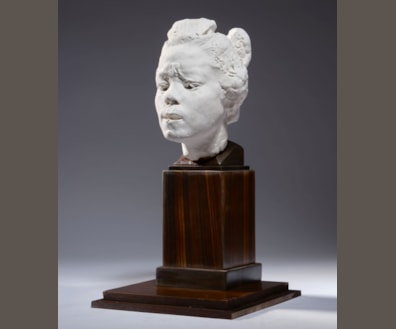
Auguste RODIN
( 1840 - 1917 )
JEUNE MÈRE À LA GROTTE
Bronze, richly dark black brown patina
H : 37,3 cm, L : 26,5 cm, D : 20,6 cm
Lifetime cast signed «Rodin», cast probably by Griffoul et Lorge.
Circa 1888-1891
Edition references (Comité Rodin inclusion letter n°2013-4139B):
15 identified examples including 13 lifetime ones.
H : 37,3 cm, L : 26,5 cm, D : 20,6 cm
Lifetime cast signed «Rodin», cast probably by Griffoul et Lorge.
Circa 1888-1891
Edition references (Comité Rodin inclusion letter n°2013-4139B):
15 identified examples including 13 lifetime ones.
Detailed Description
In the tradition of J.-B. Carpeaux’s maternity sculptures (La Tendresse maternelle, Jeune mère et son enfant, l’Enfant malade), the Jeune mère à la grotte is part of a series of studies that Rodin undertook between 1885 and 1893 on the feminine theme of Tenderness. This theme is expressed through the filial bond in the relief version of Jeune mère à la grotte (1885), but also in the form of groups in the round with Jeune mère (1885) and l’Amour qui passe (before 1893), in which the child is transformed into a winged putto, reclining on its mother’s lap. This tenderness later becomes fraternal, with the group Frère et Soeur (1890-1891).
It turns out that the relief of the Jeune mère, originally intended for the top of the left pilaster of the Porte de l’Enfer, is the starting point for these studies on the expression of family feelings. Although Rodin abandoned the project to integrate it into the monument of a lifetime, preferring the Cariatide à la pierre, he remained aware of its decorative and architectural dimension by including it in the sculptural work to be carried out for the Hôtel Fenaille (1886), a marble creation, definitively settled with the artist in 1889.
Rodin particularly appreciated this intimate relief, identified by various names: Jeune mère, Caresse Maternelle, Femme et Enfant dans sa grotte and Coquille femme et enfant. He exhibited it in bronze at the Pavillon de l’Alma in 1900 (n° 92, former Peytel collection) and donated an example to Claude Monet in 1886 in exchange of a painting of Belle Ile view (the bronze is now at the Marmottan Museum in Paris).
Between 1888 and 1905, Rodin turned to the foundrymen he used to work with at that time, Léon Perzinka, Griffoul & Lorge, Adolphe Gruet and Alexis Rudier, to produce a shared edition of this model, estimated at thirteen lifetime pieces, to which were added two posthumous examples, initiated by the Rodin Museum cast by Alexis Rudier foundry.
The bronze we are presenting, cast between 1888 and 1891, probably by the Griffoul et Lorge foundry, is distinguished by the quality of its cast, which highlights the protagonists, and its unique patina, with its subtle shades of green.
It turns out that the relief of the Jeune mère, originally intended for the top of the left pilaster of the Porte de l’Enfer, is the starting point for these studies on the expression of family feelings. Although Rodin abandoned the project to integrate it into the monument of a lifetime, preferring the Cariatide à la pierre, he remained aware of its decorative and architectural dimension by including it in the sculptural work to be carried out for the Hôtel Fenaille (1886), a marble creation, definitively settled with the artist in 1889.
Rodin particularly appreciated this intimate relief, identified by various names: Jeune mère, Caresse Maternelle, Femme et Enfant dans sa grotte and Coquille femme et enfant. He exhibited it in bronze at the Pavillon de l’Alma in 1900 (n° 92, former Peytel collection) and donated an example to Claude Monet in 1886 in exchange of a painting of Belle Ile view (the bronze is now at the Marmottan Museum in Paris).
Between 1888 and 1905, Rodin turned to the foundrymen he used to work with at that time, Léon Perzinka, Griffoul & Lorge, Adolphe Gruet and Alexis Rudier, to produce a shared edition of this model, estimated at thirteen lifetime pieces, to which were added two posthumous examples, initiated by the Rodin Museum cast by Alexis Rudier foundry.
The bronze we are presenting, cast between 1888 and 1891, probably by the Griffoul et Lorge foundry, is distinguished by the quality of its cast, which highlights the protagonists, and its unique patina, with its subtle shades of green.
You may also like