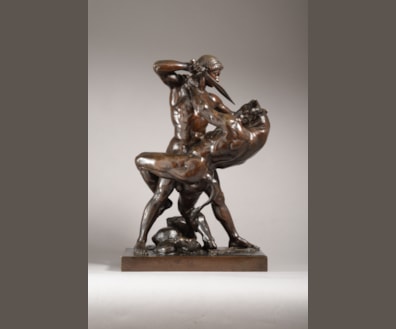
Jean-Baptiste CARPEAUX
( 1827 - 1875 )
LA DANSE
Sketch with background (1865-1866)
Terracotta, pink patina «Atelier-Dépôt à Auteuil, 71 rue Boileau, Paris» (seal).
H : 51 cm, L : 35,6 cm, D : 22,8 cm
Lifetime example signed and dated in the clay before kilning «J. Bte Carpeaux, 1874», «Propriété Carpeaux» studio (Imperial Eagle seal), in its original display case (restoration report available).
Kilned in 1874
Provenance :
Carpeaux Studio, 1874
Carpeaux Sale from May 23th 1874, Lot n°1 : « esquisse inédite » (purchased by Mme. Francoeur)
Descendance of Francoeur, Poidatz, Dutilleul Francoeur.
Purchased in 2025 from the descendance through the Galerie Florian Daguet Bresson (Paris).
Terracotta, pink patina «Atelier-Dépôt à Auteuil, 71 rue Boileau, Paris» (seal).
H : 51 cm, L : 35,6 cm, D : 22,8 cm
Lifetime example signed and dated in the clay before kilning «J. Bte Carpeaux, 1874», «Propriété Carpeaux» studio (Imperial Eagle seal), in its original display case (restoration report available).
Kilned in 1874
Provenance :
Carpeaux Studio, 1874
Carpeaux Sale from May 23th 1874, Lot n°1 : « esquisse inédite » (purchased by Mme. Francoeur)
Descendance of Francoeur, Poidatz, Dutilleul Francoeur.
Purchased in 2025 from the descendance through the Galerie Florian Daguet Bresson (Paris).
Detailed Description
After Carpeaux’s first two designs featuring "a winged genius hovering above two figures" (see the first terracotta sketch p. 12), this third sketch, the one accepted by Charles Garnier for the Opera in Paris, depicts four dancers surrounding the Genius, who has a female attitud. It defines the entire Danse of the final group, which will include four additional figures. Originally, only two figures and one Genie were planned for this high relief accompanying the architecture, as for the three others on the front of the Opera.
This vibrantly modelled terracotta, as full of Light and Life, is one of seven identified in this material and the only one known to have been made in 1874 during the artist’s lifetime; it is important for the History of Edition because it reveals that Carpeaux was the first sculptor to edit his sketches. This is mentioned in the first catalogue in which they appear, that of the Carpeaux sale on May 23rd 1874: "Esquisses inédites".
In 1874, although the sculptor regularly lived beyond his means and on credit, and was in dire need of money, the edition of these sketches was as much a financial necessity as it was an avant-garde vision of art. This innovative vision valued unfinished works as much as finished ones, an approach that can also be found in his pictorial production and which the 20th century would adopt as its own.
This vibrantly modelled terracotta, as full of Light and Life, is one of seven identified in this material and the only one known to have been made in 1874 during the artist’s lifetime; it is important for the History of Edition because it reveals that Carpeaux was the first sculptor to edit his sketches. This is mentioned in the first catalogue in which they appear, that of the Carpeaux sale on May 23rd 1874: "Esquisses inédites".
In 1874, although the sculptor regularly lived beyond his means and on credit, and was in dire need of money, the edition of these sketches was as much a financial necessity as it was an avant-garde vision of art. This innovative vision valued unfinished works as much as finished ones, an approach that can also be found in his pictorial production and which the 20th century would adopt as its own.
You may also like