

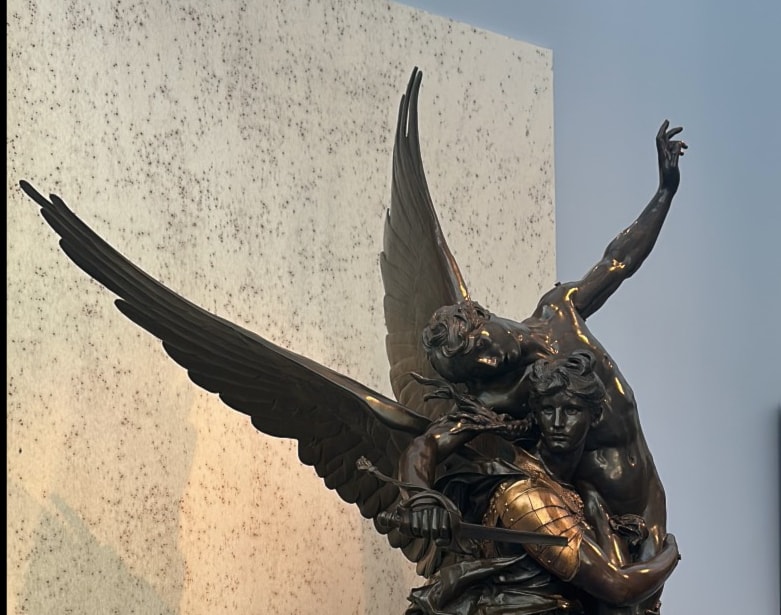


Marius-Jean-Antonin Mercié
( 1845 - 1916 )
GLORIA VICTIS
Reduction n°1 bronze (3/5 from the original), richly shaded brown patina with gilt highlights.
H : 187 cm, L : 112 cm, D : 91 cm
Signed «A.Mercié» with the «F. Barbedienne Fondeur» mark, presented as model with assembly and mounting pins parts, the one described in the Barbedienne catalogue raisonné (Rionnet, 2016) : «le janvier 1912, le sculpteur autorise l’éditeur à monter en épreuve et à mettre en vente le modèle n°1», a second example in this size currently at the Musée des Augustins in Toulouse.
Circa 1880-1912
Exhibition references of the model :
Salon in 1874 (plaster), in 1875 (bronze)
Universal Exhibition (1878)
Century Exhibition of French Art (1900)
H : 187 cm, L : 112 cm, D : 91 cm
Signed «A.Mercié» with the «F. Barbedienne Fondeur» mark, presented as model with assembly and mounting pins parts, the one described in the Barbedienne catalogue raisonné (Rionnet, 2016) : «le janvier 1912, le sculpteur autorise l’éditeur à monter en épreuve et à mettre en vente le modèle n°1», a second example in this size currently at the Musée des Augustins in Toulouse.
Circa 1880-1912
Exhibition references of the model :
Salon in 1874 (plaster), in 1875 (bronze)
Universal Exhibition (1878)
Century Exhibition of French Art (1900)
Detailed Description
"GLORIA VICTIS": AN EXCEPTIONAL BRONZE
This example is exceptional in terms of its size: it is a half-life-size cast, reduction n°1, three-fifths the size of the original. There are believed to be no more than a dozen examples of this size, including the only one identified in museum, which is held by the Musée des Augustins in Toulouse, the sculptor’s birthplace. Above all, this is not just any bronze, but the master model – the reproduction matrix – partially reassembled as an example, with mounting pins visible in some places. This bronze is mentioned in a note dated January 29th 1912 on the model’s production sheet: "the sculptor authorises the editor to assemble an example and put [model] number one up for sale".
A RARE MODEL AND THE LEGACY OF BARBEDIENNE
This type of preparation is extremely rare for a bronze. It was sometimes designed as an exhibition model to showcase the quality of the casting and the skill of the founder. At the beginning of the 20th century, Barbedienne had become the world specialist in monumental castings and the leading founder of his time.
The original-size bronzes, measuring over three metres in height, are not available in private collections. They can be found in the Petit Palais museum in Paris, the Glyptotek in Copenhagen and, as painful reminders of France’s defeat in 1871, in public squares in many major French cities (Agen, Bordeaux, Châlons-en-Champagne, Cholet, Niort, etc.).
ARTISTIC MERIT AND COMMERCIAL SUCCESS
In terms of subject matter, Gloria Victis is, along with David vainqueur de Goliath, one of the artist’s two masterpieces with political connotations. It was produced just after the defeat in 1871, when the sculptor was young, and sent to the Salon in 1874 where, when the time was right, it was a resounding success and was purchased by the French State.
Its genius is already contained in the title: Gloria Victis, glory to the vanquished. In a vertical and dynamic composition, the subject is softened by the vitality he infuses it with: Glory seems to fly with the young fighter as if to carry him away to a happy immortality. The composition is treated in a neo-Florentine style, where the beauty of the characters could almost make one forget the spirit of defeat: aesthetics prevail over the subject.
This explains the editorial success of the group, except for the large dimensions. Experience showed that large formats were shunned by bronze enthusiasts in the 19th century: the preferred size was half ours, as it could then be "reasonably" placed on a piece of furniture, chest of drawers or column in the interiors of the time.
This example is exceptional in terms of its size: it is a half-life-size cast, reduction n°1, three-fifths the size of the original. There are believed to be no more than a dozen examples of this size, including the only one identified in museum, which is held by the Musée des Augustins in Toulouse, the sculptor’s birthplace. Above all, this is not just any bronze, but the master model – the reproduction matrix – partially reassembled as an example, with mounting pins visible in some places. This bronze is mentioned in a note dated January 29th 1912 on the model’s production sheet: "the sculptor authorises the editor to assemble an example and put [model] number one up for sale".
A RARE MODEL AND THE LEGACY OF BARBEDIENNE
This type of preparation is extremely rare for a bronze. It was sometimes designed as an exhibition model to showcase the quality of the casting and the skill of the founder. At the beginning of the 20th century, Barbedienne had become the world specialist in monumental castings and the leading founder of his time.
The original-size bronzes, measuring over three metres in height, are not available in private collections. They can be found in the Petit Palais museum in Paris, the Glyptotek in Copenhagen and, as painful reminders of France’s defeat in 1871, in public squares in many major French cities (Agen, Bordeaux, Châlons-en-Champagne, Cholet, Niort, etc.).
ARTISTIC MERIT AND COMMERCIAL SUCCESS
In terms of subject matter, Gloria Victis is, along with David vainqueur de Goliath, one of the artist’s two masterpieces with political connotations. It was produced just after the defeat in 1871, when the sculptor was young, and sent to the Salon in 1874 where, when the time was right, it was a resounding success and was purchased by the French State.
Its genius is already contained in the title: Gloria Victis, glory to the vanquished. In a vertical and dynamic composition, the subject is softened by the vitality he infuses it with: Glory seems to fly with the young fighter as if to carry him away to a happy immortality. The composition is treated in a neo-Florentine style, where the beauty of the characters could almost make one forget the spirit of defeat: aesthetics prevail over the subject.
This explains the editorial success of the group, except for the large dimensions. Experience showed that large formats were shunned by bronze enthusiasts in the 19th century: the preferred size was half ours, as it could then be "reasonably" placed on a piece of furniture, chest of drawers or column in the interiors of the time.
You may also like


