Alfred JANNIOT
( 1889 - 1969 )
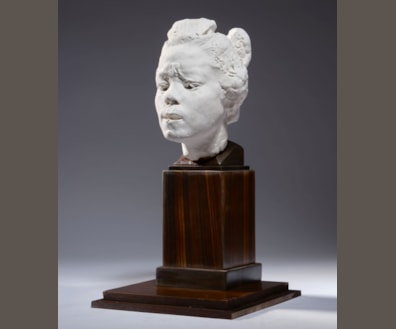
«TÊTE IDÉALE» ou «La Sicilienne» (1924)
Lens limestone.
H : 41,4 cm, L : 25 cm, D : 23,5 cm
Artist carve signed «A.Janniot».
Circa 1924-1930
Museum references :
One Limestone example at the Hirshhorn Museum (inv. 79.8)
Provenance :
Galerie Michel Giraud (Paris),
Private collection.
Detailed Description
After winning the Prix de Rome for Sculpture in 1919, our artist stayed at the Villa Medici between January 1920 and June 1924. This Roman period is decisive in the formation of his plastic language. Indeed, confronted daily with the ancient art and sculpture of the Italian Renaissance, Janniot deepens an ideal of Classical Beauty. During this stay, he also meets several artists with whom he forms lasting ties. We can notice notably the painter Jean Dupas as well as the architects Roger Séassal and Michel Roux-Spitz who will regularly use him for ambitious decorative projects.
At the Villa Médicis, he created many portraits. For this, young models come to pose for him, including a young Italian from the Mezzogiorno. Seduced by her beauty, he dedicates a sculpture to her that he first titled La Sicilienne, before she was later renamed Tête Idéale.
The example is characterized by a great softness of modelling, a perfect oval, a lowered gaze marked with restraint and an inner expression that evokes ancient canons. However, Janniot is not limited to a historicist reference: the stylized treatment of the hair and the headgear, simplified and geometrized, announcing the Art Deco aesthetic. This subtle alliance between Classicism and Modernity constitutes one of the major signatures of his oeuvre.
A marble version was presented in 1925 in the Grand Salon of Jacques-Émile Ruhlmann’s Hôtel du Collectionneur, during the International Exhibition of Modern Decorative and Industrial Arts. Close friend of Janniot, Ruhlmann (1879-1933) immediately recognizes the emblematic strength of this piece, which he chooses to embody the decorative ideal of his pavilion.
The example studied here, in Lens limestone, is distinguished by a delicate touch of red applied to the lips. This rare detail brings a subtle chromatic vibration and reinforces the sensitive presence of the face.
At the Villa Médicis, he created many portraits. For this, young models come to pose for him, including a young Italian from the Mezzogiorno. Seduced by her beauty, he dedicates a sculpture to her that he first titled La Sicilienne, before she was later renamed Tête Idéale.
The example is characterized by a great softness of modelling, a perfect oval, a lowered gaze marked with restraint and an inner expression that evokes ancient canons. However, Janniot is not limited to a historicist reference: the stylized treatment of the hair and the headgear, simplified and geometrized, announcing the Art Deco aesthetic. This subtle alliance between Classicism and Modernity constitutes one of the major signatures of his oeuvre.
A marble version was presented in 1925 in the Grand Salon of Jacques-Émile Ruhlmann’s Hôtel du Collectionneur, during the International Exhibition of Modern Decorative and Industrial Arts. Close friend of Janniot, Ruhlmann (1879-1933) immediately recognizes the emblematic strength of this piece, which he chooses to embody the decorative ideal of his pavilion.
The example studied here, in Lens limestone, is distinguished by a delicate touch of red applied to the lips. This rare detail brings a subtle chromatic vibration and reinforces the sensitive presence of the face.
You may also like