Jean DUNAND
( 1877 - 1942 )
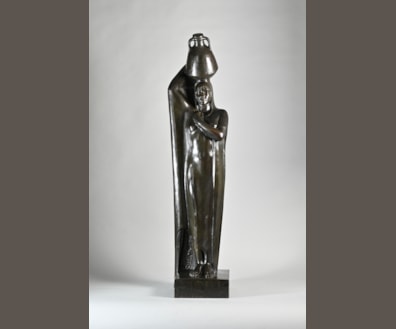
NAJA DRESSÉ (1914)
Bronze, richly dark black brown patina, with red and gilt highlights
H : 31,6 cm, L : 27 cm, D : 13,1 cm
Lifetime cast signed "Jean Dunand" with tool, Amélie Marcilhac certificate n°2025 XII 02-3/3.
Circa 1925-1930
H : 31,6 cm, L : 27 cm, D : 13,1 cm
Lifetime cast signed "Jean Dunand" with tool, Amélie Marcilhac certificate n°2025 XII 02-3/3.
Circa 1925-1930
Detailed Description
Jean DUNAND born on May 20, 1877 in Lancy, Switzerland, is the son of a gold founder in the watch industry. Born Jules-John, he takes his name from 1909. He began his artistic training at the age of 14 at the School of Industrial Art of Geneva, where he took class in drawing and sculpture. He graduated from this school in 1895. At that time, he became friends with François-Louis Schimied, Carl Angst and Claudius Linossier, all three future Art Deco artist as well.
With a scholarship from the city of Geneva, in 1897 he moved permanently to Paris where he practiced as an apprentice engraver in the modeling and decoration in the studio of his uncle.
A year later, he attended the evening classes of the National School of Decorative Arts in the sculptor’s studio of Jean Dampt. Thanks to this, he enhanced his taste for meticulous work as well as a great knowledge of carved materials such as wood, stone, ivory as well as precious metals. He opened his studio in 1899 in which he worked until the end of his life.
All his career, our artist was interested by artistic trends as well as different artistic techniques. First, after his education in Geneva, Dunand created many bronze sculptures. We can see the one who made him win a Gold medal at the Universal Exhibition of 1900, Quo Vadis.
From 1903, he began his activity as a private mansion designer which allows him to work both with wainscot sculpture and furniture. Two year later, he dedicates to the technique of copperware. With this technique, he learns to work the volumes from simple sheet of metal and produces many pieces in the Art Nouveau style with plant and animal forms.
In 1909, he became a member of the Society of Decorative Artists and participated to all the exhibitions. In 1912, he was introduced to the technique of lacquer by a Japonese master named Seizo Sugawara. Jean Dunand subsequently made lacquer his material of choice. Thanks to him, this technique renewed its image of classic style, taking on a new lease of life in the decorative arts of the period and becoming one of the hallmarks of Art deco. He also inspired other artists such as Gaston Suisse.
Today, his Oeuvre enjoys international renown. His creations are preserved in major institutions such as the Musée d’Orsay, the Art Institute of Chicago or in the Metropolitan Museum of Art.
THE NAJA : An emblematic theme of Jean Dunand
This Naja dressé demonstrates the artist’s virtuosity in the early year of his career as a sculptor. Drawing on his training as a chiseller and his interest in animal forms, this piece reveals a remarkable sense of movement and uses the plasticity of the reptile’s body. Dunand offers then several poses for desk accessories.
Our example has some golden and red scales that enliven the surfaces and are comparable to those of the two examples in the MET.
The details like the work on the scales shows the artist’s research for the natural texture and the dynamics of forms. The snake is a motive he would repeat throughout his career, a figure as threatening as elegant, which became emblematic of the decorative vocabulary of Art deco, also synonymous with exotism, drawing inspiration form the Middle East.
The posture is reminiscent of certain cobra designs by Paul Jouve, illustrator of some editions of Rudyard Kipling's The Jungle Book, whose studies were directly reproduced by Jean Dunand for lacquer compositions.
Najas au corps lové or dressé by Dunand are in line with the articulated animal figures (jizai okimono) made in bronze by the descendants of Myôchin, a family of armourers who have been renowned since the 14th century for their production of samurai armor and swords (katana).
With a scholarship from the city of Geneva, in 1897 he moved permanently to Paris where he practiced as an apprentice engraver in the modeling and decoration in the studio of his uncle.
A year later, he attended the evening classes of the National School of Decorative Arts in the sculptor’s studio of Jean Dampt. Thanks to this, he enhanced his taste for meticulous work as well as a great knowledge of carved materials such as wood, stone, ivory as well as precious metals. He opened his studio in 1899 in which he worked until the end of his life.
All his career, our artist was interested by artistic trends as well as different artistic techniques. First, after his education in Geneva, Dunand created many bronze sculptures. We can see the one who made him win a Gold medal at the Universal Exhibition of 1900, Quo Vadis.
From 1903, he began his activity as a private mansion designer which allows him to work both with wainscot sculpture and furniture. Two year later, he dedicates to the technique of copperware. With this technique, he learns to work the volumes from simple sheet of metal and produces many pieces in the Art Nouveau style with plant and animal forms.
In 1909, he became a member of the Society of Decorative Artists and participated to all the exhibitions. In 1912, he was introduced to the technique of lacquer by a Japonese master named Seizo Sugawara. Jean Dunand subsequently made lacquer his material of choice. Thanks to him, this technique renewed its image of classic style, taking on a new lease of life in the decorative arts of the period and becoming one of the hallmarks of Art deco. He also inspired other artists such as Gaston Suisse.
Today, his Oeuvre enjoys international renown. His creations are preserved in major institutions such as the Musée d’Orsay, the Art Institute of Chicago or in the Metropolitan Museum of Art.
THE NAJA : An emblematic theme of Jean Dunand
This Naja dressé demonstrates the artist’s virtuosity in the early year of his career as a sculptor. Drawing on his training as a chiseller and his interest in animal forms, this piece reveals a remarkable sense of movement and uses the plasticity of the reptile’s body. Dunand offers then several poses for desk accessories.
Our example has some golden and red scales that enliven the surfaces and are comparable to those of the two examples in the MET.
The details like the work on the scales shows the artist’s research for the natural texture and the dynamics of forms. The snake is a motive he would repeat throughout his career, a figure as threatening as elegant, which became emblematic of the decorative vocabulary of Art deco, also synonymous with exotism, drawing inspiration form the Middle East.
The posture is reminiscent of certain cobra designs by Paul Jouve, illustrator of some editions of Rudyard Kipling's The Jungle Book, whose studies were directly reproduced by Jean Dunand for lacquer compositions.
Najas au corps lové or dressé by Dunand are in line with the articulated animal figures (jizai okimono) made in bronze by the descendants of Myôchin, a family of armourers who have been renowned since the 14th century for their production of samurai armor and swords (katana).
You may also like