

Naoum ARONSON
( December 25, 1872 - September 30, 1943 )
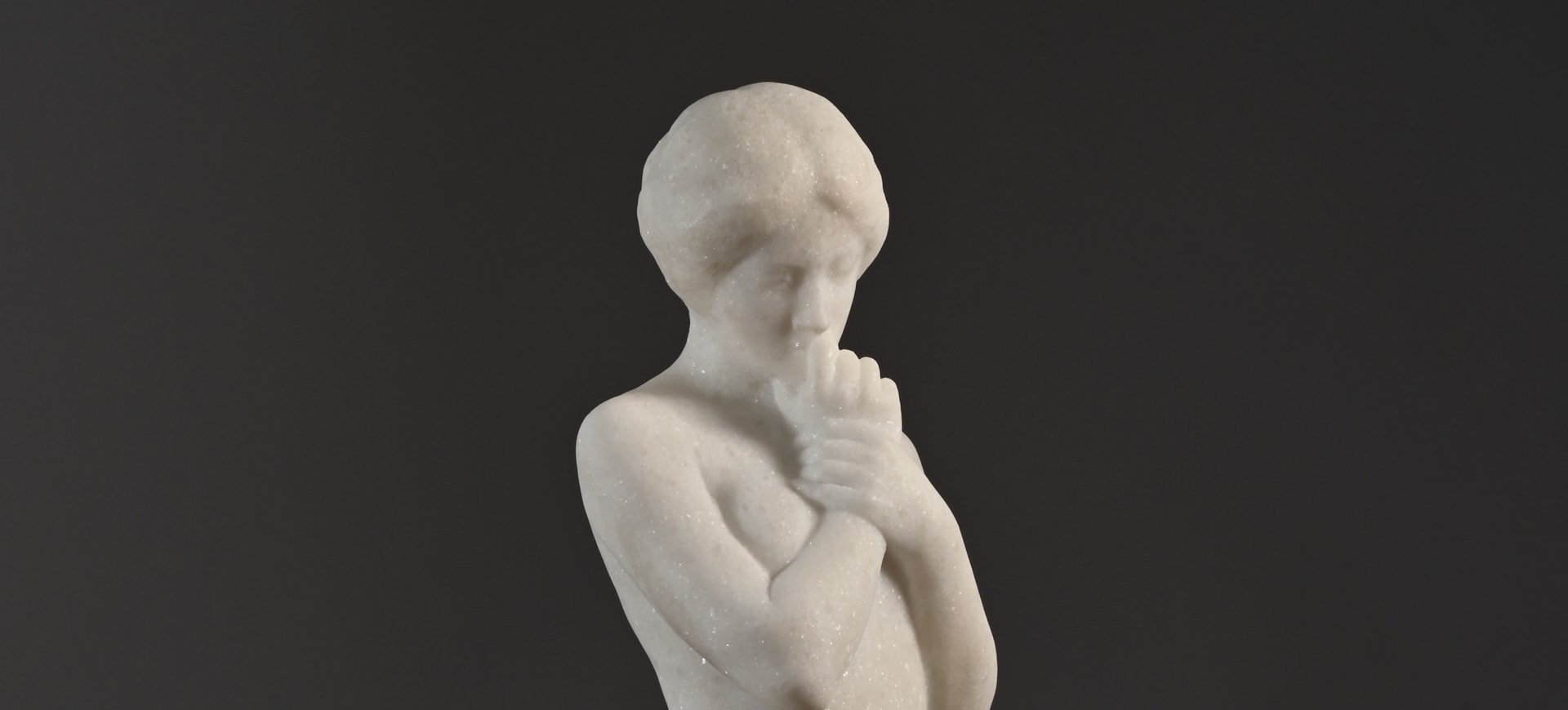
ÈVE (1910)
Marble, probably dolomite from the Greek Thasos Island
H : 79,2 cm, L : 21,8 cm, P : 24,5 cm
Direct carve by the artist signed «n.aronson» on the left side of the rock.
Circa 1910
H : 79,2 cm, L : 21,8 cm, P : 24,5 cm
Direct carve by the artist signed «n.aronson» on the left side of the rock.
Circa 1910
Detailed Description
Born in Kraslava, in present-day Lithuania, on 25 December 1872, Naoum was the son of a family of Jewish merchants. He began his artistic training at the Vilnius Academy of Arts in 1889. In 1891, he continued his studies in Paris at the École Nationale Supérieure des Arts Décoratifs, where he studied under the sculptor Hector Lemaire, while also taking classes in sculpture from life at the Académie Colarossi. He also frequented Auguste Rodin's studio, which would have a profound influence on his style.
Aronson's style is considered ‘sculptural symbolism’. He combines movement and sensitivity, learned from Rodin, with his own spiritual and emotional exploration. He attaches great importance to the face and internalised expressions.
Life in Paris was initially quite difficult for him. For several years, he lived in precarious conditions in the Montparnasse district, where many Russian students, like himself, resided. To support himself, he worked as a stonemason and labourer.
At the beginning of the 20th century, the Russian community played a major role in Parisian artistic life. With its numerous associations and community centres, the Montparnasse district became a hub for artistic exchanges and encounters, with Naoum among its members. Other big names such as Chana Orloff, Marc Chagall and even Ossip Zadkine could also be found there.
In 1897, he exhibited for the first time in Paris at the Salon de la Société Nationale des Beaux-Arts, held at the Champ de Mars, with L'Au-Delà, a marble low relief, and Portrait de Mr. Manoury, a plaster bust. This exhibition marked the beginning of his career. Aronson went on to complete several official commissions in France. Among them was the decoration of the Palais de Chaillot. He also had other commissions internationally, such as in the United States, Russia and even the Prussian Empire. He became famous for his busts of great intellectual and political figures such as Ludwig van Beethoven, Louis Pasteur and Vladimir Lenin. He also created larger works such as the sculpted group for the L'Offrande fountain.
His participation in the 1900 Paris World's Fair in the Russian section earned him great recognition. He subsequently returned regularly to his native country, particularly after the October Revolution of 1917.
In 1926, a retrospective was dedicated to him at the Galerie Decour in Paris. It featured 75 sculptures and 54 drawings spanning his entire career. Among these works was the bronze bust of Tolstoy, created in 1905 following their meeting in 1902. This exhibition was also an opportunity to present the artist's portrait gallery, featuring artists such as Beethoven. This subject, along with Tolstoy, is the sculptor's best known, reflecting the thematic personalities of his former colleague Bourdelle.
He was appointed Officer of the Legion of Honour in 1938 for his entire career, reflecting his influence in the Parisian artistic world.
With the German occupation in 1940, Aronson went into exile because of his Jewish origins. He travelled through Portugal and settled with his wife in the United States, where he lived in New York like many sculptors of the time, such as Zadking and Chagall. On 30 September 1943, he was found dead in his studio on the Upper West Side.
Today, his works can be found in several institutions in France, such as the Petit Palais, the Musée du Luxembourg, and the Musée d'Art et d'Histoire du Judaïsme, as well as in international institutions such as the Musée d'Art et d'Histoire in Geneva, Switzerland, and the David Yakobashvili Museum in Russia. Although these museums have a number of works by our sculptor in their collections, it is at the Petah Tikva Museum of Art in Israel that most of his work can be seen, following two exhibitions dedicated to him in 2001 and 2017. In 1998, Genya Markon bequeathed an archive to the Paris City Library. His family had received this important collection from Luba Aronson, the sculptor's niece. It includes a large collection of photographs and archives that allow us to rediscover this artist who remained in the shadow of other sculptors of his time.
Aronson's style is considered ‘sculptural symbolism’. He combines movement and sensitivity, learned from Rodin, with his own spiritual and emotional exploration. He attaches great importance to the face and internalised expressions.
Life in Paris was initially quite difficult for him. For several years, he lived in precarious conditions in the Montparnasse district, where many Russian students, like himself, resided. To support himself, he worked as a stonemason and labourer.
At the beginning of the 20th century, the Russian community played a major role in Parisian artistic life. With its numerous associations and community centres, the Montparnasse district became a hub for artistic exchanges and encounters, with Naoum among its members. Other big names such as Chana Orloff, Marc Chagall and even Ossip Zadkine could also be found there.
In 1897, he exhibited for the first time in Paris at the Salon de la Société Nationale des Beaux-Arts, held at the Champ de Mars, with L'Au-Delà, a marble low relief, and Portrait de Mr. Manoury, a plaster bust. This exhibition marked the beginning of his career. Aronson went on to complete several official commissions in France. Among them was the decoration of the Palais de Chaillot. He also had other commissions internationally, such as in the United States, Russia and even the Prussian Empire. He became famous for his busts of great intellectual and political figures such as Ludwig van Beethoven, Louis Pasteur and Vladimir Lenin. He also created larger works such as the sculpted group for the L'Offrande fountain.
His participation in the 1900 Paris World's Fair in the Russian section earned him great recognition. He subsequently returned regularly to his native country, particularly after the October Revolution of 1917.
In 1926, a retrospective was dedicated to him at the Galerie Decour in Paris. It featured 75 sculptures and 54 drawings spanning his entire career. Among these works was the bronze bust of Tolstoy, created in 1905 following their meeting in 1902. This exhibition was also an opportunity to present the artist's portrait gallery, featuring artists such as Beethoven. This subject, along with Tolstoy, is the sculptor's best known, reflecting the thematic personalities of his former colleague Bourdelle.
He was appointed Officer of the Legion of Honour in 1938 for his entire career, reflecting his influence in the Parisian artistic world.
With the German occupation in 1940, Aronson went into exile because of his Jewish origins. He travelled through Portugal and settled with his wife in the United States, where he lived in New York like many sculptors of the time, such as Zadking and Chagall. On 30 September 1943, he was found dead in his studio on the Upper West Side.
Today, his works can be found in several institutions in France, such as the Petit Palais, the Musée du Luxembourg, and the Musée d'Art et d'Histoire du Judaïsme, as well as in international institutions such as the Musée d'Art et d'Histoire in Geneva, Switzerland, and the David Yakobashvili Museum in Russia. Although these museums have a number of works by our sculptor in their collections, it is at the Petah Tikva Museum of Art in Israel that most of his work can be seen, following two exhibitions dedicated to him in 2001 and 2017. In 1998, Genya Markon bequeathed an archive to the Paris City Library. His family had received this important collection from Luba Aronson, the sculptor's niece. It includes a large collection of photographs and archives that allow us to rediscover this artist who remained in the shadow of other sculptors of his time.
You may also like