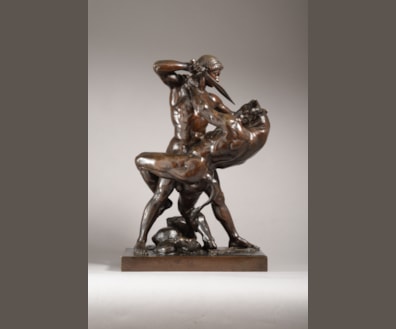
Antoine-Louis BARYE
( 1795 - 1875 )
LION DÉVORANT UN SANGLIER (c. 1874)
"New model" from the Barye catalogue published in 1874.
Original plaster with wax retouches from the Barye after death sale in 1876.
H : 15,6 cm, L : 29,3 cm, D : 15 cm
Stamped with the "Barye" sale seal on a small wax plate.
Provenance :
Plaster from the Barye sale (n°588 : “Modèle en bronze avec son plâtre”).
Former Heilbronner Collection
Exhibited at the Barye Retrospective in 1889 (n°646)
Former Strauss collection.
Former Collection Haviland
Former Dubreuil Collection
Former UDB Collection Former BB collection
"Nouveau modèle" du dernier catalogue publié vers 1874.
Plâtre original retouché à la cire, provenant de la vente Barye en 1876.
Haut : 15,6 cm, Long : 29,3 cm, Prof : 15 cm
Estampillé "Barye" sur une petite plaquette de cire.
Provenance :
Vente Barye
Ancienne collection Strauss.
Original plaster with wax retouches from the Barye after death sale in 1876.
H : 15,6 cm, L : 29,3 cm, D : 15 cm
Stamped with the "Barye" sale seal on a small wax plate.
Provenance :
Plaster from the Barye sale (n°588 : “Modèle en bronze avec son plâtre”).
Former Heilbronner Collection
Exhibited at the Barye Retrospective in 1889 (n°646)
Former Strauss collection.
Former Collection Haviland
Former Dubreuil Collection
Former UDB Collection Former BB collection
"Nouveau modèle" du dernier catalogue publié vers 1874.
Plâtre original retouché à la cire, provenant de la vente Barye en 1876.
Haut : 15,6 cm, Long : 29,3 cm, Prof : 15 cm
Estampillé "Barye" sur une petite plaquette de cire.
Provenance :
Vente Barye
Ancienne collection Strauss.
Detailed Description
With an unedited version, this model follows the idea of the Lion s’élançant sur un sanglier from the Surtout for the Duke of Orléans (1810-1842). By its composition, its dynamism, powerful representation full of surface details, it is one of the most achieved groups depicting a romantic fight in the Barye collection. It belongs to the 47 new models last minute added in the last Barye catalogue circa 1874, to be edited from a chief-model with this purpose.
We think the lifetime edition is only about few examples, a smaller number than what we estimate in 2000 in the catalogue raisonné. From the publication of the book, only two examples have been identified over 22 years, including the one reproduced in the catalogue raisonné, recently proposed on the market. Usually, the renowned models by Barye were still requested during his time, moreover when they were also exhibited by depositaries; the new models, produced at the end of his career, were unexploited and some were only cast in one example for the after death sale.
This plaster belonged to the after death sale of the artist in 1876 where it is identified under the number 588, "plâtre avec son chef-modèle en bronze" and we included in the Barye Retrospective at the Fine Arts School in 1889. The darkest parts are wax retouches, which belong completely to the creative process of the sculptor, who complained that he was very slow for that.
You may also like