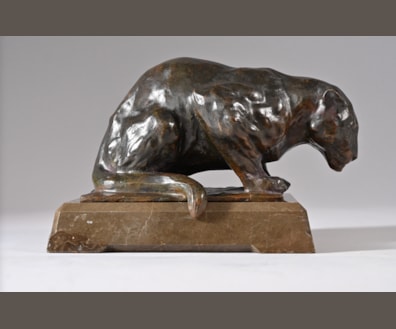
Alfredo PINA
( 1887 - 1966 )
CHEVAL AU REPOS
Bronze, richly dark brown patina.
H : 26.3 cm, L : 45.4 cm, D : 17.2 cm
Lifetime cats signed "Pina", dated "1917".
Cast in 1917
Detailed Description
Born in 1883 in Milan, Alfredo Pina initially studied sculpture at the Accademia di Brera, under the influence of Prince Troubetzkoy with his Impressionist style. In 1911, he arrived in Paris, which was then in the midst of a Rodin craze, and became one of Rodin’s collaborators. He set up a studio on Rue du Maine, next to that of Bourdelle, Rodin’s studio chief.
A master of marble sculpture, he chose to depict human passions and torments in this material, but also in bronze, a whole collection of which was exhibited at the Galerie Allard in 1920 to great acclaim. He was also reknown during his lifetime as a portraitist and, like many of his contemporaries, was fascinated by the figure of the composer Beethoven, a supreme genius who transcended his art and with whom most artists of the early 20th century identified. During the 1920s, the young Italian state, seeking to define its national identity, launched a project for a monument to the poet Dante, which the leading sculptors of the time were commissioned to work on. Troubetzkoy submitted a model, but it was Pina’s proposal that became indisputably associated with the project, which was ultimately never realised.
The sculptor settled permanently in Mesves-sur-Loire, where the local museum in La Charité-sur-Loire acquired his studio collection upon his death in 1966, thanks to the French Museum of Modern Art.
His works were featured in major exhibitions such as the Venice Biennale in 1920 and 1922 and are held in most international museums, including the National Gallery in Washington (Bust of Richard Wagner, 1916).
Among his corpus, are several groups of horses dating from around 1920. Our horse, dated ‘1917’, is likely to be one of his very earliest subjects. Its posture is reminiscent not only of the horses imagined by Troubetzkoy during his stay in Russia, but also of Francesco Fanelli’s tradition of grazing horses.
You may also like