Alfred BOUCHER
( 1850 - 1934 )
L'HISTOIRE NUE
Against a wall
Sketched rectangular wall, crenelated upper part.
Statuary white marble.
H : 104.5 cm, L : 46.4 cm, D : 27 cm
Signed «A Boucher» in the left lower part.
Provenance : example of the artist’s collection, kept at home until 1943, Villa des Colonnes in Aix-les-Bains. Purchased in 1943 by the grandfather of the previous owners with the Villa until 2026; UDB collection.
Only three examples identified by monsieur Piette, this one being, before signature, the origin of the plaster mould one (A 59-5 from the catalogue raisonné [model for both other marbles : A59-6 for this one avec half circled wall and inv. UDB 161107 for the reduction, non finito for the right feet]).
Before 1934
Sketched rectangular wall, crenelated upper part.
Statuary white marble.
H : 104.5 cm, L : 46.4 cm, D : 27 cm
Signed «A Boucher» in the left lower part.
Provenance : example of the artist’s collection, kept at home until 1943, Villa des Colonnes in Aix-les-Bains. Purchased in 1943 by the grandfather of the previous owners with the Villa until 2026; UDB collection.
Only three examples identified by monsieur Piette, this one being, before signature, the origin of the plaster mould one (A 59-5 from the catalogue raisonné [model for both other marbles : A59-6 for this one avec half circled wall and inv. UDB 161107 for the reduction, non finito for the right feet]).
Before 1934
Detailed Description
Alfred Boucher was born in 1850 in a village near Nogent-sur-Seine. He was introduced to sculpture by Marius Ramus, for whom his father worked as a gardener. Ramus soon introduced his young protégé to another sculptor from Nogent, Paul Dubois. Thanks to Dubois, Boucher was awarded a scholarship in 1871, allowing him to enrol at the École des Beaux-Arts in Paris and subsequently travel to Rome in 1877–1878. During his studies, he also met Camille Claudel in Nogent-sur-Seine and became her first sculpture teacher.
From 1874 onwards, Alfred Boucher exhibited at the Salon des Artistes Français, where his works caused a sensation: Eve après la faute (2nd-class medal, 1878), Vénus Astarté (1880) … With La Piété filiale, he won the Salon prize in 1881, and the French government commissioned him to create a monumental version, which was unveiled in Nogent-sur-Seine in 1886.
It was following another stay in Rome that he created his most iconic and modern works, both of which being acquired by the State for the Jardin du Luxembourg: Au But in 1886 and À la Terre in 1890. Among the official commissions for the City of Paris were the Monument à Eugène Flachat (1897) and Inspiration for the facade of the Grand Palais (1900). He also played a key role in promoting young foreign talent, both painters and sculptors, by establishing La Ruche in the Vaugirard plain, offering them a home and a creative space for a modest rent. Painters such as Chagall, Modigliani and Soutine, as well as sculptors such as Archipenko, Zadkine and Lipchitz created their first Parisian works there.
Today, beyond his numerous commissions and official purchases, Boucher’s reputation rests on his masterful handling of marble. He is known for creating direct carvings in marble and only occasionally worked with craftsmen. The State acquired three major marble works: Le Repos in 1892, Volubilis in 1897 for the Musée du Luxembourg, and La Pensée in 1907, now housed at the Musée du Petit Palais. He thus created a new world centered on the female nude, where the body is crystalline, sensual and fluid, where the pose captures a natural movement. Following in Carpeaux’s footsteps, he was drawn to the complexity of the body’s contorsions. Against this backdrop, his subjects take on a universal dimension, exploring themes such as pain, memory and posterity…
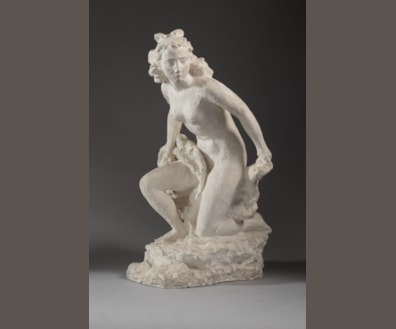
L’Histoire nue is part of this quest for absolute eternity. It stems from the development of La Philosophie de l’Histoire, a high-relief sculpture which he exhibited for the first time at the Salon in 1898. Philosophy takes the form of a nude woman, seen in profile, her youthful head looking up towards the sky, her hair loose, lying flat against the stele. With L’Histoire nue, the female figure becomes the author, taking a step back from the history of humanity. This marble sculpture, bearing no dedication and captivating by its monumentality, by the sensuality of the young woman’s back, stands as the guardian of a stele with no visible letters inscribed, thus leaving room for our imagination and our personal stories. The sculptor plays on this effect and encourages us to interpret the work by enlivening the surface of the wall with a delicate interplay of horizontal lines interspersed with vertical sections. Alfred Boucher employs a Michelangelo-style non finito to subtly connect the body of this allegory to the stele. By giving depth to his non finito, he creates a distance between the nude body and the wall. The intended and achieved effect is that of a true full-relief sculpture. The woman thus appears to us in the entirety of her nudity. The sculptor’s virtuosity is expressed through expert carving which brings life and suppleness to a perfect body, as well as through the thoughtful choice of statuary marble of the highest quality.
According to Mr. Jacques Piette, author of the sculptor’s catalogue raisonné, there are only two other marble sculptures of this theme: a smaller one (H: 64.4 cm, W: 31.5 cm), with a tapering side and a non finito at the base of the right foot (formerly in the Univers du Bronze collection, inv. UDB 161107); and another marble sculpture that differs from ours in that it features a less naturalistic stele, topped by a decorative hemisphere.
In his book, Mr. Piette published a photograph of the artist’s studio showing an unsigned plaster cast that closely resembles our marble sculpture. He agrees that this plaster cast was made from our marble sculpture before the marble was signed. In all likelihood, our marble sculpture—the original—was the first version of this subject to be created and served as the basis for the two other versions known today.
Particularly fond of this marble sculpture, the sculptor decided to keep it in his villa, built in Aix-les-Bains in 1917. Following the artist’s death, the new owners of the villa purchased it along with certain works that had remained on the premises, including this exceptional marble sculpture, which was passed down within the same family for several decades.
From 1874 onwards, Alfred Boucher exhibited at the Salon des Artistes Français, where his works caused a sensation: Eve après la faute (2nd-class medal, 1878), Vénus Astarté (1880) … With La Piété filiale, he won the Salon prize in 1881, and the French government commissioned him to create a monumental version, which was unveiled in Nogent-sur-Seine in 1886.
It was following another stay in Rome that he created his most iconic and modern works, both of which being acquired by the State for the Jardin du Luxembourg: Au But in 1886 and À la Terre in 1890. Among the official commissions for the City of Paris were the Monument à Eugène Flachat (1897) and Inspiration for the facade of the Grand Palais (1900). He also played a key role in promoting young foreign talent, both painters and sculptors, by establishing La Ruche in the Vaugirard plain, offering them a home and a creative space for a modest rent. Painters such as Chagall, Modigliani and Soutine, as well as sculptors such as Archipenko, Zadkine and Lipchitz created their first Parisian works there.
Today, beyond his numerous commissions and official purchases, Boucher’s reputation rests on his masterful handling of marble. He is known for creating direct carvings in marble and only occasionally worked with craftsmen. The State acquired three major marble works: Le Repos in 1892, Volubilis in 1897 for the Musée du Luxembourg, and La Pensée in 1907, now housed at the Musée du Petit Palais. He thus created a new world centered on the female nude, where the body is crystalline, sensual and fluid, where the pose captures a natural movement. Following in Carpeaux’s footsteps, he was drawn to the complexity of the body’s contorsions. Against this backdrop, his subjects take on a universal dimension, exploring themes such as pain, memory and posterity…
L’Histoire nue is part of this quest for absolute eternity. It stems from the development of La Philosophie de l’Histoire, a high-relief sculpture which he exhibited for the first time at the Salon in 1898. Philosophy takes the form of a nude woman, seen in profile, her youthful head looking up towards the sky, her hair loose, lying flat against the stele. With L’Histoire nue, the female figure becomes the author, taking a step back from the history of humanity. This marble sculpture, bearing no dedication and captivating by its monumentality, by the sensuality of the young woman’s back, stands as the guardian of a stele with no visible letters inscribed, thus leaving room for our imagination and our personal stories. The sculptor plays on this effect and encourages us to interpret the work by enlivening the surface of the wall with a delicate interplay of horizontal lines interspersed with vertical sections. Alfred Boucher employs a Michelangelo-style non finito to subtly connect the body of this allegory to the stele. By giving depth to his non finito, he creates a distance between the nude body and the wall. The intended and achieved effect is that of a true full-relief sculpture. The woman thus appears to us in the entirety of her nudity. The sculptor’s virtuosity is expressed through expert carving which brings life and suppleness to a perfect body, as well as through the thoughtful choice of statuary marble of the highest quality.
According to Mr. Jacques Piette, author of the sculptor’s catalogue raisonné, there are only two other marble sculptures of this theme: a smaller one (H: 64.4 cm, W: 31.5 cm), with a tapering side and a non finito at the base of the right foot (formerly in the Univers du Bronze collection, inv. UDB 161107); and another marble sculpture that differs from ours in that it features a less naturalistic stele, topped by a decorative hemisphere.
In his book, Mr. Piette published a photograph of the artist’s studio showing an unsigned plaster cast that closely resembles our marble sculpture. He agrees that this plaster cast was made from our marble sculpture before the marble was signed. In all likelihood, our marble sculpture—the original—was the first version of this subject to be created and served as the basis for the two other versions known today.
Particularly fond of this marble sculpture, the sculptor decided to keep it in his villa, built in Aix-les-Bains in 1917. Following the artist’s death, the new owners of the villa purchased it along with certain works that had remained on the premises, including this exceptional marble sculpture, which was passed down within the same family for several decades.
You may also like